Egg Seamless Pattern: A Designer's Guide to Whimsical Vector Art
Every now and then, a design asset arrives that feels both playful and meticulously crafted. The Egg Seamless Pattern is exactly that kind of find. It takes a deceptively simple subject—fried eggs, sunny-side up, rendered with careful hand-drawn detail—and turns it into a repeatable pattern that works across a surprisingly wide range of projects. Whether you are designing packaging for a breakfast cafe, building a playful wallpaper collection, or creating social media templates for a food blog, this vector art offers a fresh alternative to generic geometric repeats and predictable botanical motifs.
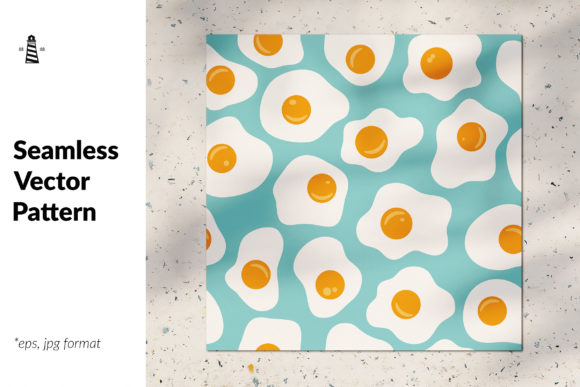
The strength of this pattern lies in its balance. The hand-drawn quality gives each egg a sense of character—slight irregularities in the yolk, gentle variations in the white—while still maintaining the consistency needed for seamless tiling. At 69 x 69 inches at 300 dpi, you are working with a canvas that can scale down to a greeting card or stretch across an entire wall without losing detail. The included EPS and AI vector files mean you retain full editability, which is crucial when you need to tweak colors, scale elements, or combine the pattern with other design assets.
Visual Personality and Hand-Drawn Charm
What sets this pattern apart from mass-produced vector repeats is the evident care in the line work. The fried eggs are not uniform clip-art shapes. Each one has a slightly organic contour—the white spreads in uneven, natural curves, and the yolk sits with a gentle irregularity that feels authentic. The hand-drawn approach gives the asset a warmth that purely digital vectors often lack. This makes it particularly effective for projects where you want to convey homemade quality, comfort, or a sense of craft.
The pattern sits comfortably in the space between illustration and graphic design. It is detailed enough to hold interest at close viewing distances, yet structured enough to read clearly when scaled back. The overall style is friendly without being childish, which is a tricky balance to achieve. You can imagine it on a ceramic egg cup set or a linen tea towel just as easily as on a web page background for a farm-to-table restaurant. The personality is versatile enough to support both rustic and modern contexts, depending on how you deploy it.
Where the Pattern Shines Across Creative Projects
Because the Egg Seamless Pattern is delivered as a high-resolution vector and raster pair (EPS, AI, and JPG), it adapts to a wide variety of outputs. Here are some of the most practical applications you can explore:
- Packaging design – Egg cartons, gourmet food boxes, spice blends, and kitchen product packaging benefit from the pattern's direct thematic connection and handcrafted feel.
- Textiles and home goods – Tea towels, aprons, napkins, cushion covers, and even ceramic mugs can carry this pattern as a subtle or dominant motif.
- Wallpaper and wall art – Whether for a kitchen accent wall or a playful nursery, the 69-inch width at 300 dpi ensures crisp reproduction at large scales.
- Gift wrap and stationery – The pattern's cheerful yet sophisticated style works well for food-themed gift paper, recipe card sets, and thank-you notes.
- Digital backgrounds – Use it as a repeat on a food blog, social media graphics for a brunch campaign, or a zoom background for a cooking class.
- Brand identity assets – Restaurants, cafes, food trucks, and specialty grocery stores can use this pattern as a secondary brand element on menus, signage, and takeout bags.
One area where this pattern particularly excels is editorial design. If you are working on a cookbook, a food magazine feature, or a seasonal catalog, the pattern can serve as a chapter opener background, a recipe card border, or a full-page decorative spread. The hand-drawn quality adds an artisanal layer that photographs alone often miss.
Practical Guidance for Choosing and Using the Pattern
When evaluating whether the Egg Seamless Pattern fits a specific project, start by considering the audience and context. The pattern has a natural affinity with food-related content, but it is not limited to that. Its organic, hand-drawn style can also support themes around nature, morning routines, comfort, simplicity, and nostalgia. If your brand voice leans toward playful, warm, or approachable, this pattern will likely integrate smoothly.
For designers working on brand identity, think about how the pattern interacts with other elements. Because it is a detailed repeat, it works best as a supporting texture rather than the sole visual anchor—unless the theme calls for a bold, all-over pattern. Pair it with clean sans serif typography on packaging or a simple serif font on editorial layouts to let the eggs remain the focal texture. The pattern's irregular lines pair well with modern typography that has a bit of warmth, such as a rounded sans serif or a humanist typeface. Avoid pairing it with rigid geometric fonts that feel cold or industrial.
Readability is rarely a concern with a background pattern like this, but you should still test contrast. If you place text directly over the pattern, use a solid color block behind the type or choose a very light version of the pattern adjusted in your vector software. The included AI and EPS files make these kinds of adjustments straightforward—you can reduce opacity, scale the repeat, or recolor the eggs to match a specific palette.
Commercial licensing is another practical consideration. The product listing indicates this is a commercial-use asset, but always verify the specific terms for your use case. If you plan to use the pattern on products for sale (like textiles, packaging, or digital templates), confirm that the license covers production runs and redistribution. Most quality vector art sellers offer clear licensing tiers, so read those details before launching a large project.
How the Pattern Influences Brand Perception and Engagement
Using a well-crafted hand-drawn pattern like this signals attention to detail. It tells your audience that you care about the aesthetic experience, not just the content. For a small business or a startup, investing in a premium design asset can elevate the entire brand perception without requiring a custom illustration budget. The pattern acts as a shortcut to personality—it immediately communicates a handmade, thoughtful quality that builds trust and approachability.
Consistency across touchpoints also benefits from a unified design asset. When you use the same Egg Seamless Pattern on your website background, product packaging, and social media graphics, you create a cohesive visual thread that strengthens recognition. Customers start associating the pattern with your brand, which is exactly how effective brand identity works. The pattern becomes a recognizable signature, even if it is just a supporting element.
Audience engagement often follows when a design feels distinctive and memorable. A playful pattern on a gift box or a greeting card invites a second look, and that moment of delight can translate into sharing, saving, or purchasing. For content creators and bloggers, using a unique pattern like this in pins, posts, or story backgrounds helps your visuals stand out in crowded feeds where generic stock imagery dominates.
Recommended Workflows and Creative Variations
If you are new to working with seamless pattern vectors, here is a practical approach. Open the EPS or AI file in your preferred vector software and review the layers. Because this is hand-drawn vector art, the file likely contains grouped elements that you can ungroup and recolor. Try creating a monochrome version for a subtle texture, or a pastel palette for a softer look. The 69 x 69 inch canvas at 300 dpi gives you plenty of resolution to experiment with scale—you can tile the pattern at its original size for a bold statement or reduce it significantly for a fine, subtle texture.
Another technique is to use the pattern as a mask or overlay in photo editing software. Place it over a photograph at low opacity to add texture and visual interest to a hero image on a landing page. You can also combine the pattern with geometric shapes or other repeating motifs for a more complex composition. Because the eggs are hand-drawn, they mix naturally with other organic elements like leaves, kitchen utensils, or hand-lettered typography.
For print projects, test the pattern at actual size before committing to a large run. Order a small proof on the intended substrate—paper, fabric, or ceramic—to see how the hand-drawn lines translate. The 300 dpi JPG is a safe fallback if you cannot use the vector files directly, but always prefer the vector formats for maximum flexibility, especially when scaling or recoloring.
The Egg Seamless Pattern is one of those design assets that rewards exploration. It looks simple at first glance, but the hand-drawn detail gives it depth that reveals itself across different contexts and scales. Whether you are a seasoned designer looking for a fresh texture or a small business owner building a visual identity from the ground up, this vector art offers a solid foundation with room for creativity. If you have questions about the file formats, licensing, or best ways to integrate the pattern into a specific project, reaching out to the seller is a good next step. Most creators are happy to offer guidance tailored to your use case.