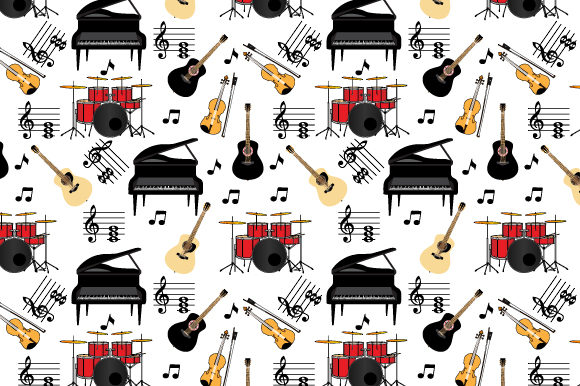
Music Instrument Seamless Pattern: A Versatile Asset for Design and Production Workflows
When you work with visual assets regularly, you quickly learn that a single well-crafted pattern can save hours of repetitive work. A music instrument seamless pattern is exactly that kind of asset. It is a repeating tile of musical instruments, notes, or related motifs that can be applied across surfaces, backgrounds, textiles, packaging, and digital interfaces without visible seams. The practical value lies not in the pattern itself but in how you integrate it into your process, whether you are designing a website, building a product line, or creating educational materials.
This article walks through what a music instrument seamless pattern is, how it fits into real creative and commercial workflows, and how you can use the included file formats to move projects forward efficiently. We focus on implementation, preparation, and long-term usability rather than abstract praise.
Understanding the Asset and Its Format Options
A seamless pattern is a graphic tile that repeats infinitely in both directions. When applied correctly, the edges match perfectly so there is no visible break. A music instrument seamless pattern typically includes stylized or realistic depictions of guitars, pianos, drums, violins, trumpets, sheet music elements, or abstract musical symbols arranged in a balanced composition.
The ZIP file you have contains three vector formats: SVG 1.1, AI 10, and EPS 10. Each serves a distinct purpose in a professional workflow:
- SVG 1.1 is ideal for web and digital use. It scales to any size without quality loss and can be edited in code or in vector software. You can embed it directly into HTML, use it in responsive designs, or manipulate it with CSS and JavaScript.
- AI 10 is native to Adobe Illustrator. It preserves layers, groups, swatches, and effects. If you work in Illustrator, this format gives you full control over every element in the pattern.
- EPS 10 is a widely compatible legacy format. It opens in most vector applications including CorelDRAW, Affinity Designer, Inkscape, and older versions of Illustrator. It is a safe choice for teams with mixed software environments.
Having all three means you can move between platforms, share with collaborators, and store a master copy that remains editable years from now.
Before a Project: Planning and Asset Preparation
If you are in the early stages of designing a brand, a product line, or a marketing campaign, a seamless pattern helps you explore visual direction quickly. You can load the pattern into a mood board, test it against color palettes, or apply it to mockups to see how it behaves at scale. This saves time compared to creating a custom pattern from scratch during the design phase.
For educators and content creators, having a pre-made pattern means one less element to commission or build. You can focus on lesson structure, video scripting, or course materials while the visual backdrop is already handled.
During a Project: Integration and Application
Once a project is underway, the pattern becomes a production tool. Consider these use cases:
- Web and UI design: Use the SVG file as a background tile for a music school website, an artist portfolio, or a streaming platform interface. Because it is vector-based, it loads quickly and adapts to different screen sizes.
- Print and packaging: Import the AI or EPS file into your layout software. Apply it to album covers, merchandise packaging, posters, or flyers. The seamless nature means you can fill any area without awkward cuts.
- Textile and surface design: If you produce fabric, wallpaper, or accessories, the pattern can be scaled and colored to match your production specifications. Vector formats are compatible with most print-on-demand services.
- Presentation and video backgrounds: Use the pattern in slides, lower thirds, or motion graphics. It adds a consistent theme without distracting from your content.
During production, you may need to modify the pattern. The AI and SVG formats allow you to change colors, rotate elements, adjust spacing, or combine the pattern with other graphics. This flexibility means you are never stuck with a fixed look.
After a Project: Archiving and Reuse
When a project is complete, the pattern becomes part of your asset library. Because you have vector files, you can revisit the pattern years later and scale it for new formats or update it for a rebrand. That long-term reusability is one of the strongest arguments for investing in well-made seamless patterns.
For freelancers and small business owners, this means you can offer consistent visual themes across multiple client projects or product lines without starting from zero each time.
Preparation and Compatibility
Before you use any of the files, confirm that your software supports the format. SVG 1.1 works in all modern browsers and in design tools like Figma, Sketch, Illustrator, and Inkscape. AI 10 requires Adobe Illustrator or a compatible import plugin. EPS 10 is broadly supported but may flatten layers in some applications. If you plan to edit the pattern heavily, use the AI file as your master and export copies as needed.
Check the pattern dimensions and resolution. Vector files have no fixed size, but the tile boundary and object proportions matter. Open the file and inspect the artboard or canvas size. If the tile is 100×100 pixels, you may need to scale it for large surfaces. Scale in multiples to avoid distortion.
Usability in Different Contexts
- For digital work: Use the SVG directly. You can change the fill color via CSS or inline styling. If you need a transparent background, confirm the pattern has no background shape. Most seamless patterns are built on a transparent base.
- For print work: Open the AI or EPS file. Set your document color mode to CMYK if you are printing commercially. Check that the pattern colors will separate correctly. If the pattern uses spot colors, decide whether you want to convert them to process colors.
- For large format output: Vector patterns scale infinitely, but software performance can slow down if the pattern contains many complex objects. Simplify shapes or reduce unnecessary detail if you plan to print at billboard size.
Organization and File Management
Keep all three formats together in a single folder. Name the folder clearly, for example "Music-Instrument-Seamless-Pattern-Bundle." Include a brief readme text file that notes the file contents, the tile size, the color palette, and any usage restrictions. This simple step saves time when you search for assets months later.
If you work with a team, upload the folder to a shared cloud drive or digital asset management system. Set permissions so everyone can access the files but only designated editors modify the master AI version.
Efficiency and Consistency
One pattern can maintain visual consistency across a entire product line. If you sell music-themed stationery, apparel, and accessories, using the same seamless pattern in different applications creates a cohesive brand experience. You only need to adjust colors or scale per product.
For bloggers and content creators, a consistent background pattern on social media graphics, blog headers, and video thumbnails reinforces your visual identity. It also cuts down the time spent designing each asset from scratch.
How This Asset Interacts with Other Tools and Methods
A music instrument seamless pattern is rarely used in isolation. It interacts with your design software, your color management system, your mockup templates, and your production pipeline.
If you use Figma for UI design, you can import the SVG pattern and apply it as a fill. In Canva, you may need to upload the PNG export if the platform does not accept vector uploads for all plan levels. For print-on-demand services like Printful or Redbubble, you typically upload a high-resolution PNG or JPEG derived from the vector file. The AI and EPS files let you export at the exact resolution each service requires.
For motion designers, the SVG file can be imported into After Effects or Premiere Pro as a vector layer. You can animate the pattern by scaling, rotating, or applying effects. The seamless tile remains intact during animation.
For developers, the SVG format allows you to use the pattern as a data URI or inline element. You can programmatically change colors, tile size, or even replace elements using JavaScript. This opens up possibilities for dynamic theming in web applications.
Checking Seamlessness
Before you use the pattern in a final product, verify that it tiles correctly. Zoom out and fill a large rectangle with the pattern. Look for obvious lines where the left meets the right and the top meets the bottom. If you see mismatches, you may need to adjust the tile boundary in the vector file. Most seamless patterns from reputable sources are already tested, but it is good practice to check, especially if you modify colors or scale.
Color Adjustments
Vector patterns often use global swatches. When you open the AI or EPS file, you can change a single swatch and the entire pattern updates. This is useful for creating color variations. For example, you might make a dark version for night-mode websites and a light version for print materials.
If you export to PNG, be mindful of banding in gradient-heavy patterns. Export at 300 PPI for print and 72 PPI for web unless your specific use case demands higher resolution.
Longevity of File Formats
SVG 1.1 has been stable since 2001 and is widely supported. AI 10 is older but Adobe software maintains backward compatibility. EPS 10 is also a mature format. By keeping copies in all three, you protect yourself against software deprecation. If a future application drops support for one format, you have fallbacks.
Store your files in a location with regular backups. Consider keeping an archive on an external drive and a copy in cloud storage. Naming conventions matter here. Include the pattern name, date, and format in the filename.
Example 1: Freelance Graphic Designer
A freelance designer is hired to create a visual identity for a children’s music school. The designer uses the music instrument seamless pattern from the bundle as a starting point. They open the AI file, adjust the colors to match the school’s palette, and scale the pattern for use on business cards, website backgrounds, and tote bags. The SVG file is embedded into the school’s WordPress site as a repeating background. The EPS file is sent to the printer for the stationery. Total time saved versus designing a custom pattern: approximately 4 to 6 hours.
Example 2: E-commerce Small Business Owner
An entrepreneur launches a line of music-themed phone cases. They import the EPS file into their mockup generator, apply it to multiple device templates, and export product images for their Shopify store. Later, they use the same pattern for fabric pouches and notebook covers. Because the pattern is seamless, there is no wasted time aligning repeats on each product photo.
Example 3: Educator Creating Course Materials
A music teacher builds an online course. They use the SVG pattern as a background for slides and quiz pages. The pattern is also used in printable worksheets and certificate templates. The consistent visual theme helps students associate the materials with the course brand. The teacher does not need any advanced design skills because the pattern is ready to use out of the box.
Final Observations on Integration
A music instrument seamless pattern is a small but powerful component in a larger workflow. Its value comes from how easily it adapts to different stages of a project and how many formats are available. By preparing your files correctly, checking compatibility early, and understanding how the pattern interacts with your existing tools, you remove friction from your process.
Whether you are a marketer creating campaign assets, a publisher designing book covers, or a hobbyist working on a personal project, the pattern saves you from repetitive design work. The three vector formats give you flexibility today and protect your investment for the future. Integrate it thoughtfully, and it becomes a set-and-forget asset that performs across mediums and timeframes.